

Quality Control in the Assisted Reproductive Technology Laboratory 1st Edition By Durai P
Original price was: $60.00.$18.00Current price is: $18.00.

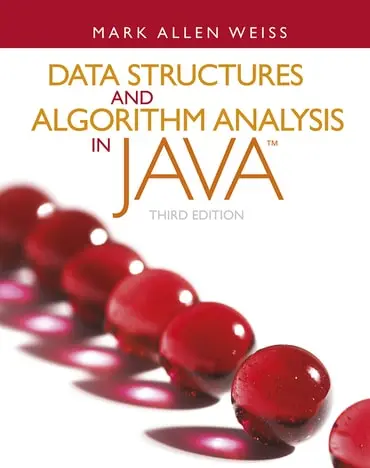
Data Structures and Algorithm Analysis in Java 3rd Edition By Mark A. Weiss
$29.00
- ISBN-10 : 0132576279
- ISBN-13 : 978-0132576277
- Ebook
- Instant Download
Description
Data Structures and Algorithm Analysis in Java 3rd Edition By Mark A. Weiss
Table of Contents
- Chapter 1 Introduction
- 1.1 What’s the Book About?
- 1.2 Mathematics Review
- 1.2.1 Exponents
- 1.2.2 Logarithms
- 1.2.3 Series
- 1.2.4 Modular Arithmetic
- 1.2.5 The P Word
- 1.3 A Brief Introduction to Recursion
- 1.4 Implementing Generic Components Pre-Java 5
- 1.4.1 Using Object for Genericity
- 1.4.2 Wrappers for Primitive Types
- 1.4.3 Using Interface Types for Genericity
- 1.4.4 Compatibility of Array Types
- 1.5 Implementing Generic Components Using Java 5 Generics
- 1.5.1 Simple Generic Classes and Interfaces
- 1.5.2 Autoboxing/Unboxing
- 1.5.3 The Diamond Operator
- 1.5.4 Wildcards with Bounds
- 1.5.5 Generic Static Methods
- 1.5.6 Type Bounds
- 1.5.7 Type Erasure
- 1.5.8 Restrictions on Generics
- 1.6 Function Objects
- Summary
- Exercises
- References
- Chapter 2 Algorithm Analysis
- 2.1 Mathematical Background
- 2.2 Model
- 2.3 What to Analyze
- 2.4 Running Time Calculations
- 2.4.1 A Simple Example
- 2.4.2 General Rules
- 2.4.3 Solutions for the Maximum Subsequence Sum Problem
- 2.4.4 Logarithms in the Running Time
- 2.4.5 A Grain of Salt
- Summary
- Exercises
- References
- Chapter 3 Lists, Stacks, and Queues
- 3.1 Abstract Data Types (ADTs)
- 3.2 The List ADT
- 3.2.1 Simple Array Implementation of Lists
- 3.2.2 Simple Linked Lists
- 3.3 Lists in the Java Collections API
- 3.3.1 Collection Interface
- 3.3.2 Iterators
- 3.3.3 The List Interface, ArrayList, and LinkedList
- 3.3.4 Example: Using remove on a LinkedList
- 3.3.5 ListIterators
- 3.4 Implementation of ArrayList
- 3.4.1 The Basic Class
- 3.4.2 The Iterator and Java Nested and Inner Classes
- 3.5 Implementation of LinkedList
- 3.6 The Stack ADT
- 3.6.1 Stack Model
- 3.6.2 Implementation of Stacks
- 3.6.3 Applications
- 3.7 The Queue ADT
- 3.7.1 Queue Model
- 3.7.2 Array Implementation of Queues
- 3.7.3 Applications of Queues
- Summary
- Exercises
- Chapter 4 Trees
- 4.1 Preliminaries
- 4.1.1 Implementation of Trees
- 4.1.2 Tree Traversals with an Application
- 4.2 Binary Trees
- 4.2.1 Implementation
- 4.2.2 An Example: Expression Trees
- 4.3 The Search Tree ADT–Binary Search Trees
- 4.3.1 contains
- 4.3.2 findMin and findMax
- 4.3.3 insert
- 4.3.4 remove
- 4.3.5 Average-Case Analysis
- 4.4 AVL Trees
- 4.4.1 Single Rotation
- 4.4.2 Double Rotation
- 4.5 Splay Trees
- 4.5.1 A Simple Idea (That Does Not Work)
- 4.5.2 Splaying
- 4.6 Tree Traversals (Revisited)
- 4.7 B-Trees
- 4.8 Sets and Maps in the Standard Library
- 4.8.1 Sets
- 4.8.2 Maps
- 4.8.3 Implementation of TreeSet and TreeMap
- 4.8.4 An Example That Uses Several Maps
- Summary
- Exercises
- References
- 4.1 Preliminaries
- Chapter 5 Hashing
- 5.1 General Idea
- 5.2 Hash Function
- 5.3 Separate Chaining
- 5.4 Hash Tables Without Linked Lists
- 5.4.1 Linear Probing
- 5.4.2 Quadratic Probing
- 5.4.3 Double Hashing
- 5.5 Rehashing
- 5.6 Hash Tables in the Standard Library
- 5.7 Hash Tables with Worst-Case O(1) Access
- 5.7.1 Perfect Hashing
- 5.7.2 Cuckoo Hashing
- 5.7.3 Hopscotch Hashing
- 5.8 Universal Hashing
- 5.9 Extendible Hashing
- Summary
- Exercises
- References
- Chapter 6 Priority Queues (Heaps)
- 6.1 Model
- 6.2 Simple Implementations
- 6.3 Binary Heap
- 6.3.1 Structure Property
- 6.3.2 Heap-Order Property
- 6.3.3 Basic Heap Operations
- 6.3.4 Other Heap Operations
- 6.4 Applications of Priority Queues
- 6.4.1 The Selection Problem
- 6.4.2 Event Simulation
- 6.5 d-Heaps
- 6.6 Leftist Heaps
- 6.6.1 Leftist Heap Property
- 6.6.2 Leftist Heap Operations
- 6.7 Skew Heaps
- 6.8 Binomial Queues
- 6.8.1 Binomial Queue Structure
- 6.8.2 Binomial Queue Operations
- 6.8.3 Implementation of Binomial Queues
- 6.9 Priority Queues in the Standard Library
- Summary
- Exercises
- References
- Chapter 7 Sorting
- 7.1 Preliminaries
- 7.2 Insertion Sort
- 7.2.1 The Algorithm
- 7.2.2 Analysis of Insertion Sort
- 7.3 A Lower Bound for Simple Sorting Algorithms
- 7.4 Shellsort
- 7.4.1 Worst-Case Analysis of Shellsort
- 7.5 Heapsort
- 7.5.1 Analysis of Heapsort
- 7.6 Mergesort
- 7.6.1 Analysis of Mergesort
- 7.7 Quicksort
- 7.7.1 Picking the Pivot
- 7.7.2 Partitioning Strategy
- 7.7.3 Small Arrays
- 7.7.4 Actual Quicksort Routines
- 7.7.5 Analysis of Quicksort
- 7.7.6 A Linear-Expected-Time Algorithm for Selection
- 7.8 A General Lower Bound for Sorting
- 7.8.1 Decision Trees
- 7.9 Decision-Tree Lower Bounds for Selection Problems
- 7.10 Adversary Lower Bounds
- 7.11 Linear-Time Sorts: Bucket Sort and Radix Sort
- 7.12 External Sorting
- 7.12.1 Why We Need New Algorithms
- 7.12.2 Model for External Sorting
- 7.12.3 The Simple Algorithm
- 7.12.4 Multiway Merge
- 7.12.5 Polyphase Merge
- 7.12.6 Replacement Selection
- Summary
- Exercises
- References
- Chapter 8 The Disjoint Set Class
- 8.1 Equivalence Relations
- 8.2 The Dynamic Equivalence Problem
- 8.3 Basic Data Structure
- 8.4 Smart Union Algorithms
- 8.5 Path Compression
- 8.6 Worst Case for Union-by-Rank and Path Compression
- 8.6.1 Slowly Growing Functions
- 8.6.2 An Analysis By Recursive Decomposition
- 8.6.3 An O(M log * N) Bound
- 8.6.4 An O( M α (M, N) ) Bound
- 8.7 An Application
- Summary
- Exercises
- References
- Chapter 9 Graph Algorithms
- 9.1 Definitions
- 9.1.1 Representation of Graphs
- 9.2 Topological Sort
- 9.3 Shortest-Path Algorithms
- 9.3.1 Unweighted Shortest Paths
- 9.3.2 Dijkstra’s Algorithm
- 9.3.3 Graphs with Negative Edge Costs
- 9.3.4 Acyclic Graphs
- 9.3.5 All-Pairs Shortest Path
- 9.3.6 Shortest-Path Example
- 9.4 Network Flow Problems
- 9.4.1 A Simple Maximum-Flow Algorithm
- 9.5 Minimum Spanning Tree
- 9.5.1 Prim’s Algorithm
- 9.5.2 Kruskal’s Algorithm
- 9.6 Applications of Depth-First Search
- 9.6.1 Undirected Graphs
- 9.6.2 Biconnectivity
- 9.6.3 Euler Circuits
- 9.6.4 Directed Graphs
- 9.6.5 Finding Strong Components
- 9.7 Introduction to NP-Completeness
- 9.7.1 Easy vs. Hard
- 9.7.2 The Class NP
- 9.7.3 NP-Complete Problems
- Summary
- Exercises
- References
- 9.1 Definitions
- Chapter 10 Algorithm Design Techniques
- 10.1 Greedy Algorithms
- 10.1.1 A Simple Scheduling Problem
- 10.1.2 Huffman Codes
- 10.1.3 Approximate Bin Packing
- 10.2 Divide and Conquer
- 10.2.1 Running Time of Divide-and-Conquer Algorithms
- 10.2.2 Closest-Points Problem
- 10.2.3 The Selection Problem
- 10.2.4 Theoretical Improvements for Arithmetic Problems
- 10.3 Dynamic Programming
- 10.3.1 Using a Table Instead of Recursion
- 10.3.2 Ordering Matrix Multiplications
- 10.3.3 Optimal Binary Search Tree
- 10.3.4 All-Pairs Shortest Path
- 10.4 Randomized Algorithms
- 10.4.1 Random Number Generators
- 10.4.2 Skip Lists
- 10.4.3 Primality Testing
- 10.5 Backtracking Algorithms
- 10.5.1 The Turnpike Reconstruction Problem
- 10.5.2 Games
- Summary
- Exercises
- References
- 10.1 Greedy Algorithms
- Chapter 11 Amortized Analysis
- 11.1 An Unrelated Puzzle
- 11.2 Binomial Queues
- 11.3 Skew Heaps
- 11.4 Fibonacci Heaps
- 11.4.1 Cutting Nodes in Leftist Heaps
- 11.4.2 Lazy Merging for Binomial Queues
- 11.4.3 The Fibonacci Heap Operations
- 11.4.4 Proof of the Time Bound
- 11.5 Splay Trees
- Summary
- Exercises
- References
- Chapter 12 Advanced Data Structures and Implementation
- 12.1 Top-Down Splay Trees
- 12.2 Red-Black Trees
- 12.2.1 Bottom-Up Insertion
- 12.2.2 Top-Down Red-Black Trees
- 12.2.3 Top-Down Deletion
- 12.3 Treaps
- 12.4 Suffix Arrays and Suffix Trees
- 12.4.1 Suffix Arrays
- 12.4.2 Suffix Trees
- 12.4.3 Linear-Time Construction of Suffix Arrays and Suffix Trees
- 12.5 k-d Trees
- 12.6 Pairing Heaps
- Summary
- Exercises
- References
Index
Reviews (0)
Shipping & Delivery


MAECENAS IACULIS
Vestibulum curae torquent diam diam commodo parturient penatibus nunc dui adipiscing convallis bulum parturient suspendisse parturient a.Parturient in parturient scelerisque nibh lectus quam a natoque adipiscing a vestibulum hendrerit et pharetra fames nunc natoque dui.
ADIPISCING CONVALLIS BULUM
- Vestibulum penatibus nunc dui adipiscing convallis bulum parturient suspendisse.
- Abitur parturient praesent lectus quam a natoque adipiscing a vestibulum hendre.
- Diam parturient dictumst parturient scelerisque nibh lectus.
Scelerisque adipiscing bibendum sem vestibulum et in a a a purus lectus faucibus lobortis tincidunt purus lectus nisl class eros.Condimentum a et ullamcorper dictumst mus et tristique elementum nam inceptos hac parturient scelerisque vestibulum amet elit ut volutpat.
Reviews
There are no reviews yet.